
For many people the answer is a small emergency fund first, then aggressive credit card payoff, then a larger fund once the cards are gone. A starter cushion keeps a flat tire or a surprise bill from landing back on the card, and after that every extra dollar usually does more good against a high-interest balance than sitting in savings. There is no official number for the starter fund, so size it to your own costs and risks.
The tension is real because the goals pull in opposite directions. Savings usually earn a low rate and card debt can cost many times that. On paper, every dollar kept in savings while you carry a card balance loses money. In real life, a household with no cash and a card balance has only one way to absorb a shock, and that is more debt. This page lays out the arithmetic, a staged approach, and the situations where the order should change.
The math: savings earn little, cards cost a lot
Assume, purely for illustration, a card at 24% APR and a savings account paying 3%. On $1,000 in savings you earn about $30 a year. On $1,000 of card debt you pay about $240 a year. Holding the cash while carrying the debt costs roughly $210 a year per $1,000, about $17.50 a month. Check your real rates; both change.
That is a strong argument for paying cards first with money above a basic cushion. It is a weaker argument for the first few hundred dollars, because of what happens with no cushion at all.
The risk of having no cushion
Suppose you put every spare dollar on a card and keep $0 saved. A $600 car repair arrives. You can put it on the card, borrow from someone, or skip other bills. The most common choice is the card, which puts $600 back on a balance you just worked down, and it can derail the whole effort.
This is common. In the Federal Reserve’s report on household well-being for 2024, 63% of adults said they would cover a hypothetical $400 emergency expense using cash or its equivalent, such as savings or a card paid off at the next statement. That was unchanged from 2022 and 2023. Among those who would not use cash, some would put it on a card and pay it over time, some would borrow from family or friends, and 13% said they could not pay it at all. A starter fund fills that gap for small shocks. It does not need to cover a job loss.
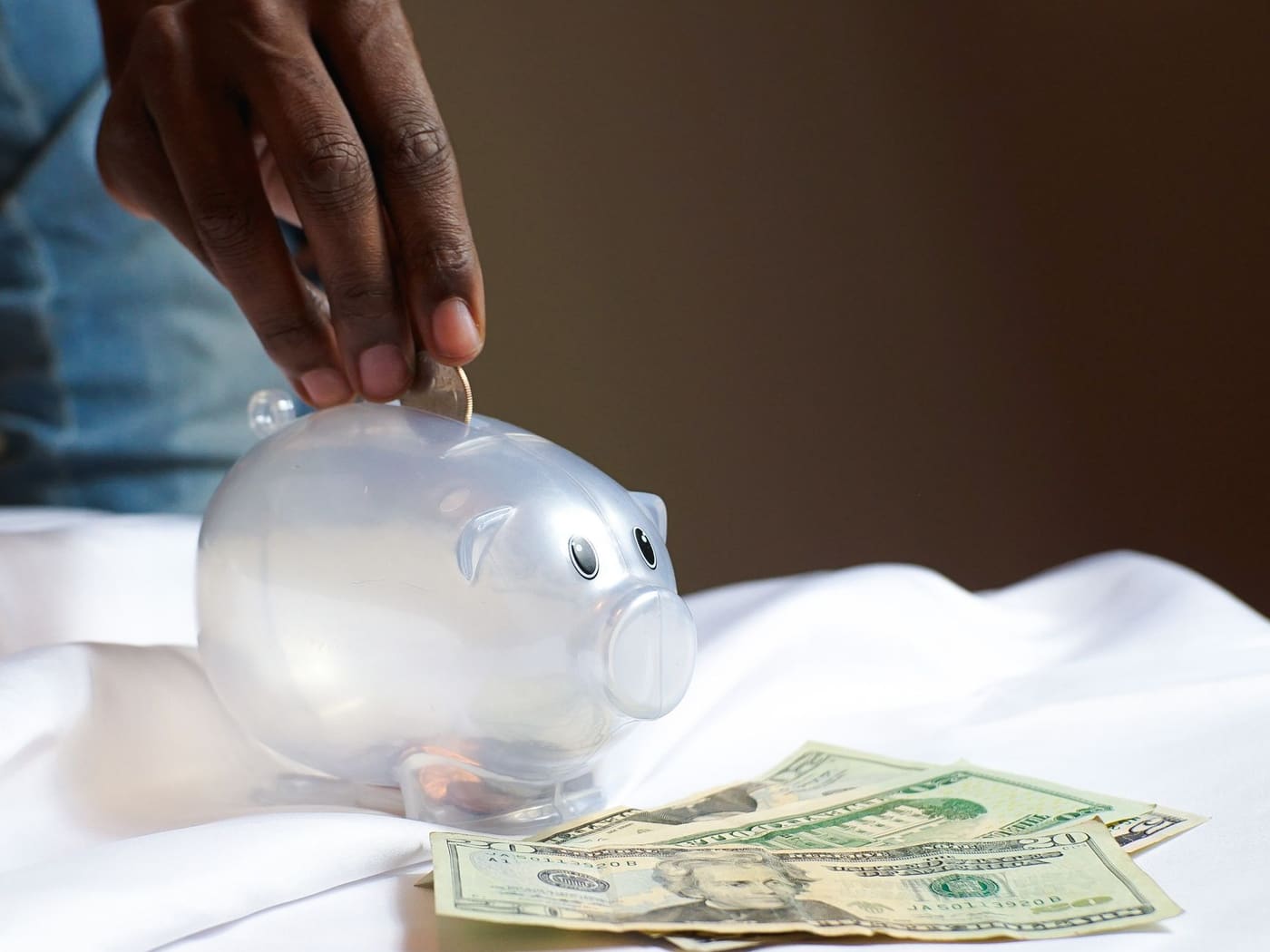
A staged approach
- Stage 1: a starter fund. Save a small buffer that covers common small shocks such as a repair, a copay, or a broken appliance. Households with high fixed costs, children, or an older car often want more.
- Stage 2: attack the card debt. Put spare cash toward the cards while keeping the starter fund intact. If you use some of it, refill it before returning to extra payments.
- Stage 3: build a full fund. After the high-interest debt is gone, build toward several months of essential expenses. A commonly suggested target is three to six months, with the higher end for people with irregular income or dependents. That is a rule of thumb, not a regulation.
For example, with $3,000 in monthly essentials, a $1,000 starter fund covers about a third of a month and a three-month fund would be $9,000. The staged approach gets the first piece quickly and does not wait on the large one while the card keeps charging interest.
When the order should change
The staged approach is a common default, not a law. Consider shifting it when:
- Income is stable, costs are low, and you have other help. A secure dual-income household might hold less and push harder on the debt.
- Income is irregular or the job is at risk. Freelancers, commission workers, or people expecting layoffs often want a bigger buffer first.
- You have dependents or a health condition. Higher expected shocks justify a bigger cushion.
- The rate is very high. Each month of delay costs more, which tilts toward a smaller starter fund and faster payoff.
- The debt is on a 0% promotion. If the balance is not accruing interest for the coming months, urgency is lower, as long as you plan to clear it before the promotion ends.
- You have a low-cost backstop. A relative who can lend, or a credit line, can reduce the cash you need to hold. Credit lines can be reduced or closed when you need them most, so they are not a substitute for savings.
Where to keep the starter fund
Keep it separate from checking so it is not tempting to spend. A savings account at a bank or credit union is the usual home. Look for an insured account (federal deposit insurance for banks and a matching program for credit unions, up to a published limit that you should check at the FDIC or NCUA), with no monthly fee and easy transfers to checking. Avoid investments that can fall in value, since the point is a stable amount available on short notice.
An automatic transfer on payday, even $25 a week, builds the cushion without a daily decision.
What counts as an emergency
Defining it in advance keeps the fund from turning into a spending account.
- Yes: an unplanned car or home repair needed to keep working or living safely, a medical bill, a lost paycheck, urgent travel for a family crisis.
- No: sales, holidays you could have planned for, routine annual costs like insurance premiums or registration, a vacation.
Predictable but irregular costs belong in a sinking fund, a separate small account you fill gradually. A $600 annual bill is $50 a month set aside.
A worked example
These are made-up numbers. Assume $400 a month is available above essentials and minimums, and a $6,000 card balance at 24%.
- Months 1 to 3: put about $350 a month toward the starter fund while making minimum payments on the card, ending with roughly $1,000 saved. The card balance barely moves and interest of roughly $120 a month keeps accruing. That is the cost of the cushion, around $360.
- Month 4 onward: send the full $400 plus the minimum, about $580 a month, to the card. That clears it in roughly a year, depending on the real minimum and interest.
- After payoff: redirect the $400 to the emergency fund.
The delay costs a few hundred dollars. In return, a surprise bill in month eight does not put $600 back on the card.
Mistakes to avoid
- Waiting for a perfect fund. Saving for months while carrying a high-rate balance can cost a lot of interest.
- Draining the fund for non-emergencies.
- Not refilling after you use it.
- Skipping minimums to save. Late fees and credit damage can cost more than the cushion helps. If you cannot make minimums, see what to do when you can only afford minimum payments.
- Treating new debt as the emergency fund. A card or credit line is a backstop, not cash.
After the starter fund is in place, the practical details of attacking the balance are in paying off credit card debt faster, and avalanche vs snowball helps with order if you have several cards.
Where this comes from
This page uses the Federal Reserve Board’s report on the economic well-being of US households in 2024, which includes the $400 expense survey result, and common personal-finance guidance for the staged approach, which is a rule of thumb rather than an official standard. The interest examples use made-up rates. Savings rates, card rates, and insurance limits change, so check them at your bank, your card statement, and the deposit insurance agencies.